-
A shaded relief map of the topography and bathymetry of the Earth on a rotating globe . (Imagery Courtesy of NASA)
-
Stuart Halewood Preparing the Plumes and Blooms CTD Seawater sampling package for a cast on the R/V Shearwater. The 7 stations from Santa Rosa Island back to the mainland are Optically and Biologically sampled monthly to depths of 400m and continue to be an important data time series for Coastal Southern california.
-
An array of seismometers stretching across the Garner Valley, California near mount San Jacinto. (photo: Hank Ratzesberger)
-
The Soil-Foundation-Structure Interaction test structure with the instrumentation hut and mountains surrounding Garner Valley, California. (photo: Hank Ratzesberger)
-
Annapurna Peak (8091m), north-central Nepal, Himalaya.
Photo provided by Doug Burbank.
-
Surface rupture from Oct 16, 1999 M7.1 Hector Mines earthquake near center of Bullion Wash Array.
Photo by Aaron Martin.
-
The Pickhandle Formation at the northern end of Owl Canyon, near Barstow, CA
Photo by Nicolas Barth
-
Peruvian Expedition.
Photo provided by Doug Burbank.
-
Hydrocarbon seeps near UCSB.
Image provided by Bruce Luyendyk's research team.
-
An animation of sea surface temperature and height anomalies in the Pacific Ocean from January 1997 to November 1998. (Imagery Courtesy of NASA)
-
3D tomographic visualization of the LA Basin.
Image provided by Kim Olsen and SCEC.
-
Students doing snow pit analysis, Sierra Nevada, CA.
Photo provided by Mike Colee
-
Legacy of hydraulic gold mining in the Sierra Nevada of California. This >20m terrace contains high Hg contamination (~8 ppm) because Hg was used to amalgamate gold. The terrace is actively eroding during large flood events. (Photo by L.A. James; provided by Michael Singer.)
-
Simulated wave propagation in the Los Angeles area for the hypothetical constant-slip rupture on the Palos Verdes fault. The component of the wavefield shown is oriented along 118 degrees measured from North, and is shown at 20 seconds after the origin time. Hot (cool) colors depict positive (negative) motion along this component, and black depicts quiescence of the waves. The surface topography, though not included in the simulation, is superimposed in the snapshot.
Graphics provide by Kim Olsen.
-
1998-04, Coyote Tracks in the Tokopah Basin of the Sierra Nevada.
Photo provided by Mike Colee
-
Legacy of hydraulic gold mining in the Sierra Nevada of California. This >20m terrace contains high Hg contamination (~8 ppm) because Hg was used to amalgamate gold. The terrace is actively eroding during large flood events. (Photo by L.A. James; provided by Michael Singer.)
-
Dusk CTD recovery, South Pacific (photo Norm Nelson)
-
North face of the central Himalaya, where the rainshadow meets the snowline.
Photo provided by Doug Burbank.
-
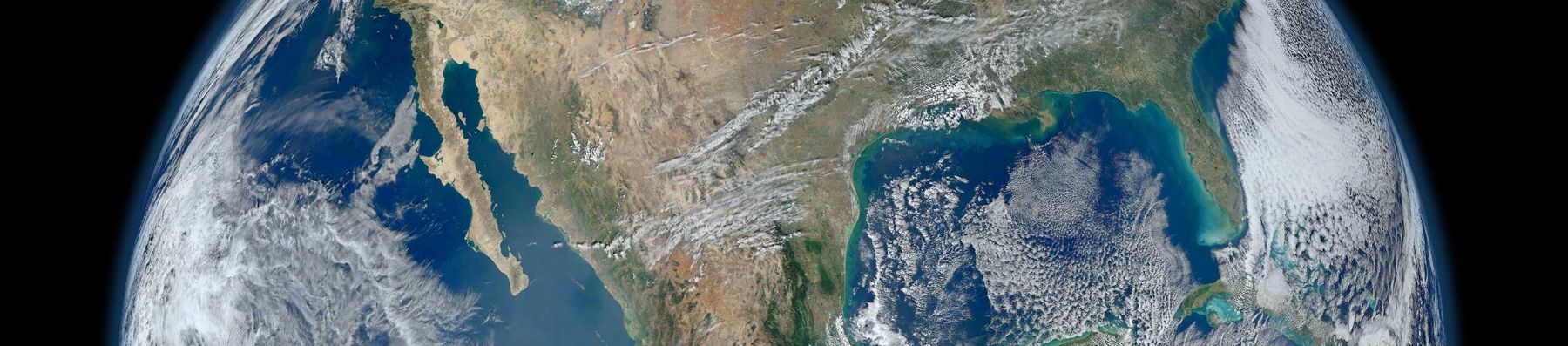
The SeaWiFS instrument looks at the world oceans and land to observe the plant life and phytoplankton, in this image you can see the vast colors of life in and around the Americas. (Imagery Courtesy of NASA)
-
Norm Nelson's group recovers the free-fall optics profiler, South Pacific (photo Melissa Miller / SIO)
-
Free-fall optics profiler, South Pacific (photo Peter Landry / WHOI)
-
Scanning Electron Microscope image of snow grains.
Photo provided by Mike Colee
-
Antarctic Expedition.
Photo provided by Bruce Luyendyk.
-
Earth view of the Western Hemisphere. Red (denoting highest ground levels of ultraviolet radiation) covers most of South America and the colors fading to blues (denoting lowest ground levels of ultraviolet radiation) over North America. This data was collected over the year 2000. (Imagery Courtesy of NASA)
-
Spinning globe showing CERES data. (Imagery Courtesy of NASA)
-
Earthquake Faults of the Santa Barbara Channel (Map image provided by Marc Kamerling and others.)
-
The research ice breaker "Nathaniel B. Palmer" in the sea ice offshore from the McMurdo station, Antarctica. ICS director Bruce Luyendyk and seven undergraduate students conducted a marine geology expedition using this vessel during Winter, 1996.
Photo by Carmen Alex.
-
High resolution (10-m) model of riparian vegetation type in the central Great Basin (Nevada, U.S.A.), derived from color infrared digital orthophotos and the SPOT5 satellite platform. (Model and image produced by Yaguang Xu, Steven Sesnie, and Brett Dickson, Northern Arizona University, in collaboration with Erica Fleishman, ERI.)
-
Core of a syncline (concave up fold) in Miocene (24-5 million years) sandstone and shale from the western Tarim Basin, China.
Photo provided by Doug Burbank.
-
Cross-polar image from snow sample at the CUESnow Study Site.
Image provided by Mike Colee
-
Professors Douglas Burbank (UCSB) and Eric Kirby (Pennsylvania State University) conduct fieldwork on the active Kunlun fault that cuts across Buddhist Tibet near the Yellow River. Strike-slip displacement on the Kunlun fault terminates near the northeastern margin of the Tibetan Plateau (see Kirby et al., Tectonics, 2007) in an area where the Yellow River is rapidly incising headward (see Harkins et al., JGR, 2007).
-
Gully development in the Bikhra catchment in the Negev Desert of Israel. These gullies are a major sediment source to the semi-arid channels draining this region. (Photo by Michael Singer.)